- Bullish on the S&P 500 · built to defend it
Only a gain in the S&P 500 can cancel a loss in the S&P 500.
We’re as bullish on the S&P 500 as anyone you’ll meet — 3D is here to make the greatest wealth engine ever built better, not to bet against it. So we defend the index with the index: the very market that creates the loss is the only one that can cancel it — a systematic, dynamic, rules-based short on the S&P 500.
Built by Eric Dugan — three decades managing index risk, fifteen of them inside two of the era’s defining systematic trading firms, with a live S&P 500 record since 2008 and a frequent guest spot on Bloomberg Television.
01 The problem
The market offers two guarantees: gains when it rises, losses when it declines.
You're only built for one.
The first builds wealth over time. The second can unbuild a decade of it in a single quarter. Both are guaranteed — and almost no one is positioned for the second.
Gold. Bonds. Bitcoin. Diversification. None of it defends you when the index falls.
There are only two things you can do about the fall: tolerate it, or offset it. The whole industry is built to help you tolerate it — diversify, ride it out, call it long-term. But tolerating a loss never cancels it. We don’t tolerate declines. We seek to offset them — with the index itself.
Only a gain in the S&P 500 cancels a loss in the S&P 500. 1 + 1 = 11.
The pattern, not the theory
Diversification is not protection.
| Worst day of 2026 (through Jun 12) | Only two S&P down years in 17 | ||
|---|---|---|---|
| Jun 5, 2026 | 2022 | 2018 | |
| S&P 500 | −2.6% | −18.1% | −4.1% |
| US Bonds | −0.8% | −21.8% | −4.6% |
| Gold | −3.1% | −0.1% | −2.1% |
| Bitcoin | −3.0% | −65.6% | −74.7% |
2018 and 2022 are the only two down years for the S&P 500 in seventeen years — and on the worst single day of this one, every “diversifier” fell right alongside it. Nowhere to hide, nothing to offset the loss. Calendar-year and single-day total returns, USD. Public market index data — not 3D Capital performance.
03 The stakes
Not losing is winning.
A loss and a gain of the same size are not equal. Fall by a third, and a 50% gain only gets you back to even. Fall by half, and you have to double. The hole is always deeper than the drop — and the higher the market climbs, the more there is to give back.
The gain required just to break even — pure arithmetic, and it accelerates against you.
Two forces make it decisive. Compounding works only on what you keep — protect the downside and every year that follows compounds from a higher number, on a bigger base. And sequence matters: a deep loss at the wrong moment — near a goal, or just after the market’s richest levels — does damage an average return never repairs.
So we lead with defense. Not losing isn’t the cautious play. Over a full cycle, it’s the winning one.
03 Our answer
Don't leave the market to survive it.
Their mousetrap asks you to step out. Ours doesn’t. Stay fully long the S&P — and defend it with a systematic short on the same index.
Offense and defense in one position. The defense waits in reserve, steps in the moment it’s needed and aside the moment it isn’t — so the long position is free to do what it does best: compound.
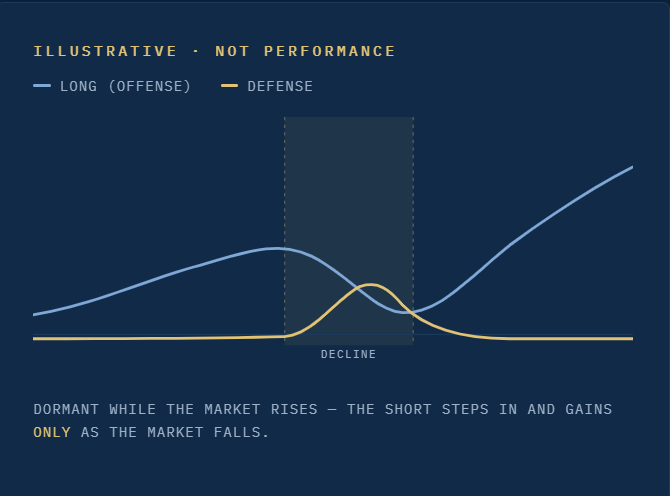
Illustrative — not performance data
Global-macro foundation
Asia opens, then Europe, then the U.S. We read that relay in real time to anticipate the day’s S&P 500 direction.
Singular focus
It distills to one clear opinion: the likely direction and magnitude of that day’s move. No drift.
Rules-based system
Systematic. No discretion, no emotion — a selective signal that filters out the noise.
Intraday by design
The large majority of active trading is intraday, with minimal overnight exposure and modest margin-to-equity.
04 The moat
Everybody knows it.
Few do it.
Because it's hard.
By now the logic is settled: the only real defense against an index loss is a position that gains when the index falls. Everybody knows it. Few do it — because doing it well is brutally hard. It means shorting the most relentless uptrend in financial history without bleeding out on the way up. It means sitting in reserve through the years the defense doesn’t pay, and being there the day it does. No drift. No discretion. No story — just a daily, rules-based call on direction.
And it’s why so few sustain it — most never attempt the short side of the S&P 500, and many who do give it all back on the way up. 3D is built to be one of the few that does it with discipline: to generate the short-side alpha the consensus calls impossible. We don’t think it’s impossible — only hard. And the hard part is the part we’ve spent a career on.
We can’t promise the market won’t fall, or that any single day goes our way. What we can promise is this: you’re running the only instrument that can cancel an S&P 500 loss — a disciplined, dynamic short on the S&P 500 itself, ready every day and put to work on a systematic, rules-based read of the market.
The tool is guaranteed. The outcome never is.05 Who built it
"I spent 15 years learning from two of the greatest traders of their generation. What I saw in 2008 told me the industry had a blind spot — and I knew exactly how to fix it. "
When the S&P 500 crashed −38% in 2008, Eric’s long-only program didn’t just survive — it finished the year up +3.3%.* The real discovery was hidden in the short signals it generated: a system that could profit from weakness when the market fell, and step aside when it rallied.
That insight became the 3D Bear program in 2011, was enhanced in 2013, and has compiled a track record across every kind of market since — short-side discipline proven through the longest bull run in history, without giving up the upside. 3D does, systematically and every day, what the industry says is too hard.
If that sounds like it shouldn’t be possible, that’s the right reaction — lasting short-side alpha is supposed to be a myth. I learned otherwise in the one place you can: on the trading desk, running systematic strategies alongside two of the people who defined the field. The 2008 result, and the live S&P 500 record built since, aren’t a lucky call — they’re what that apprenticeship, turned into a system, was made to do.
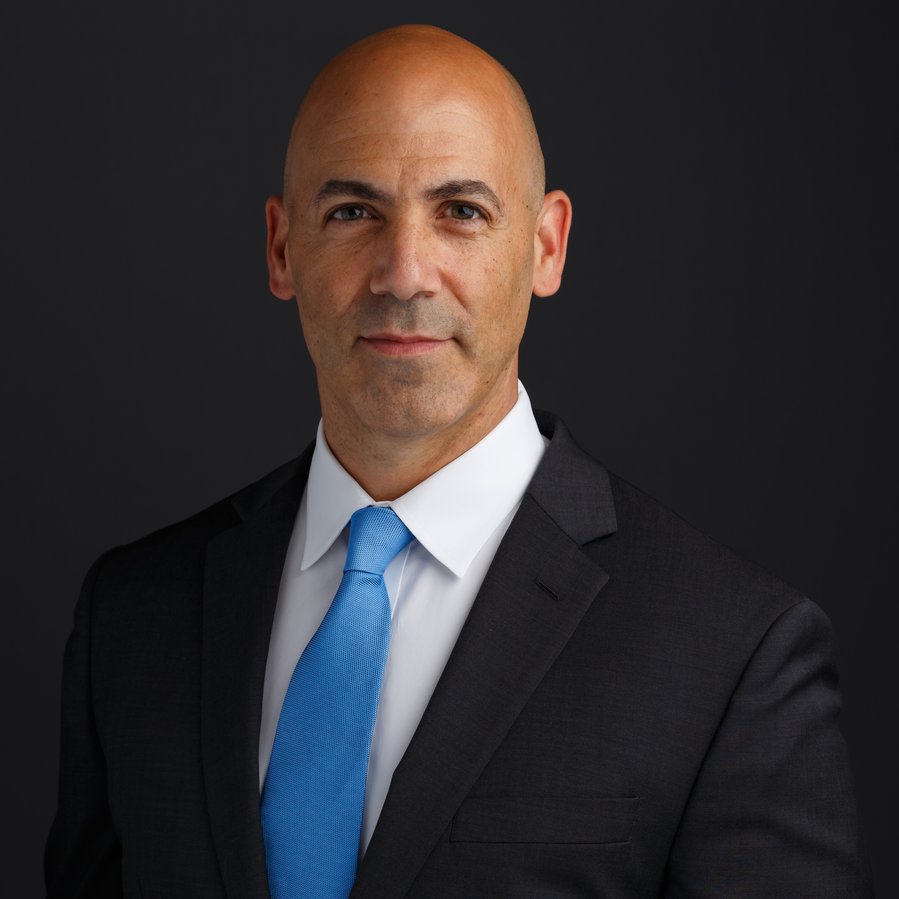
Eric Dugan
Founder & Chief Investment Officer
And it isn't theory — it's the pattern
Diversification is not
protection.
Worst Day of 2026 through June 12, 2026 | Only Two Down Years in the S&P 500 in 17 Years | ||
|---|---|---|---|
| June 5, 2026 | 2022 | 2018 | |
| S&P 500 | −2.6% | −18.1% | −4.1% |
| US Bonds | −0.8% | −21.8% | −4.6% |
| Gold | −3.1% | −0.1% | −2.1% |
| Bitcoin | −3.0% | −65.6% | −74.7% |
06 Programs
Choose your level of defense.
Long bias · Hedged
3D Hedged Equity
Seeks S&P 500 appreciation through dynamic E-mini exposure while hedging intraday declines with the 3D Bear signal — full participation, with a built-in defense.
Long / short · Symmetric
3D Long Short Equity
The full expression: dynamic long E-mini exposure to capture rallies, built on the same symmetric, rules-based logic — hedging intraday declines while also capitalizing on them.
One question
Ask it of yourself — or of whoever you trust to manage and preserve your wealth:
“When the S&P 500 falls, what do I own that's built to make money in the S&P 500?”
Not gold. Not bonds. Not something that just falls less than the index. If the honest answer is “nothing,” you haven’t done anything wrong — you’ve found the gap almost every portfolio shares. It’s the one we exist to fill.
We won’t predict the market — we prepare you for it. The day the S&P falls, you hold the only tool that can answer the loss; on the days it climbs, it steps aside so your long position is free to compound. We’re for the few who keep their guard up — who’d rather be prepared than hopeful.
If you're here to get rich, we're not it. We won't promise you a good year — we promise that the day the S&P falls, you're holding the only tool that can answer the loss.
Real protection is like insurance in one way: you don’t know you need it until you do. Most let their guard down in the good years and drop it right before the fire. We’re for the few who keep it — who’d rather be prepared than impressed. And ours doesn’t behave like ordinary insurance. That part’s behind the call.
For qualified investors ready to engage
Two ways in.
Read the thinking with no strings — the math and the history, in plain language. Or, when you’re ready, see exactly how the defense behaved in every major S&P decline since 2013.
Structured for trust — 3D Capital has no access to client funds, and clients have daily liquidity.
Start with the facts.
“Why gold, bonds, and Bitcoin won’t save you in the next decline — and what will.” Five minutes, in plain language: the arithmetic, the history, and the one defense that actually works. No gate — open to everyone.